Showing posts with label I'm a Mormon. Show all posts

Sunday, March 10, 2024

Plain and precious truths

 *I gave a talk at church today and a few people have asked for a copy of it. I decided to post it here, minus the lame intro and nervous jokes.*

I spend a lot of time with the written word, both when I’m being paid to do it and on my own time. I’ve been a big reader for as long as I can remember, and anyone who has been to my house can attest to the fact that I have a bit of a book buying problem too . . . but that’s a problem I’m okay with having.


I read primarily for one of three reasons. First, is to escape. Whether my life is boring, difficult, or just complicated, it’s always a relief to escape into another world or to deal with someone else’s problems instead of mine. Second, reading is one of my favorite stress relievers and a very necessary part of my wind-down routine at night so I can be relaxed enough to sleep. And third is, of course, to learn. I love collecting little nuggets of wisdom and seeing the world—real or imagined—through others’ eyes.


I get especially excited when those bookish life lessons I find are also gospel truths. But the scriptures and words of latter-day prophets are the best source of plain and precious truths, so this year I’ve been trying to focus more on the lessons they have to teach me.


God is a god of miracles


One truth that has been on my mind a lot the last few years is that our Father in Heaven is a god of miracles.


In the April 2022 General Conference, President Nelson said:


Moroni assured us that “God has not ceased to be a God of miracles.” Every book of scripture demonstrates how willing the Lord is to intervene in the lives of those who believe in Him. He parted the Red Sea for Moses, helped Nephi retrieve the brass plates, and restored His Church through the Prophet Joseph Smith. Each of these miracles took time and may not have been exactly what those individuals originally requested from the Lord.


In the same way, the Lord will bless you with miracles if you believe in Him, “doubting nothing.” Do the spiritual work to seek miracles. Prayerfully ask God to help you exercise that kind of faith. I promise that you can experience for yourself that Jesus Christ “giveth power to the faint; and to them that have no might he increaseth strength.” Few things will accelerate your spiritual momentum more than realizing the Lord is helping you to move a mountain in your life.


It’s not hard for me to see miracles in other people’s lives, but I struggle to see them in my own. After Pres. Nelson gave this talk though, I decided to follow his counsel and seek and expect miracles from the Lord. I did this the only way I knew how—by praying for help. I prayed for the miracles I wanted, even though past experience had left me a little bitter on that point. I prayed for help seeing the miracles that were already there, too.


I’m not going to tell you that all my dreams suddenly started coming true. But I did start seeing tiny little miracles in my own life that I was blinded to before. I became a much happier, more grateful person. I grew in ways I wasn’t expecting, and in ways I wouldn’t have if I wasn’t focused on the Savior. And as I searched for, and found, these little miracles, my faith grew as well. One of the biggest blessings is the continual realization that I love the life I have, even though it wasn’t the one I planned for.


Not all miracles are obvious and life-changing, though. In fact, most of them aren’t. More often than not, it’s the quiet miracles that help us become who we are meant to become and get where we need to go. The better I understand this, the more I'm able to see that our Father in Heaven is eager to shower us with blessings and miracles. Pres. Nelson has also said that “God will do everything He can, short of violating your agency, to help you not miss out on the greatest blessings of all eternity.” A lot of times, all we need to do is simply pay better attention.


“Salvation is free”


When I was baptized at age 8, my grandma gave me my very first journal. I wrote about my baptism when I got home that day, and have kept a journal ever since. I am currently on journal number 34. (I did say I spend a lot of time with the written word.)


I’ve thought a lot about this gift over the years, and the gift giver as well. One of my grandma’s special talents was gift giving. For her, Christmas shopping wasn’t something she did only during the holidays. She spent all year shopping and making gifts for her grandkids. She was so on top of it that even though she passed away in February, many of my cousins got presents for Christmas that year that she had bought or worked on. She also gave gifts through service. Even though she had 9 kids of her own and not a lot of money, she opened her home to any kid in the neighborhood who needed a hot meal or love and safety, and was always quick to prepare a meal for a neighbor in need. And for the last 20 years of her life, she did this while battling cancer.


I say all this not to put my grandma on an impossible-to-reach pedestal, but to provide a little bit of context into why I still think about this gift, even decades later. My grandma had a lot of grandkids. A lot of people to take care of. A lot of her own problems. I don’t know where she found the energy to get to know her shy little granddaughter who sometimes spent more time in her garden eating all her cherry tomatoes than inside visiting with her. Somehow she saw past all of my louder, more entertaining relatives and the walls I put up around myself to understand that a journal would be the right gift to give me for my 8th birthday. 


Because of that gift, journaling became a huge part of my life. It’s how I work through my problems because, as I suspect my grandma realized, I’m not the kind of person to talk to people about my problems. Writing is how I make sense of the world and my place in it. It helps me remember my life and what I’ve learned. It’s alarming the number of times I’ve reread old entries where my past self was having a grand realization about life, while my current self was thinking, “I thought I learned that for the first time a few weeks ago.” Human beings, by nature, are forgetful. It’s why the word “remember” is repeated so many times in The Book of Mormon—if we don’t make a conscious effort to remember what we’ve learned, we could lose it completely.


The journal I got on my baptism day is a gift that keeps giving, both because it was profoundly personal and continues to bless my life today.


All of us have access to an even greater gift, one that is exactly what we need, more than we deserve, and always there to bless us. That gift, of course, is the atonement. Lehi teaches us in 2 Nephi 2:4 that “salvation is free.” He didn’t mean “free” in the modern sense of the word. We don’t have to qualify for it. There are no preexisting conditions or circumstances that disqualify us from it. And we won’t be bombarded with ads for the rest of our life because of it.


This gift is free because it was given out of love. All we have to do is accept it.


In this month’s issue of the Liahona, President Jeffrey R. Holland teaches us:


Jesus Christ has made it clear that all Heavenly Father’s children have equal claim on the blessings of His gospel and Atonement. He reminds us that all “are privileged the one like unto the other, and none are forbidden” (2 Nephi 26:28).


“He inviteth them all to come unto him and partake of his goodness; and he denieth none that come unto him, black and white, bond and free, male and female” (2 Nephi 26:33).


“He inviteth them all”—that means all of us! We should not place superficial labels and artificial distinctions on ourselves or others. We should never put up any barriers to the Savior’s love or entertain thoughts that we or others are beyond His reach. As I have said before, “It is not possible for [anyone] to sink lower than the infinite light of Christ’s Atonement shines.”


Instead, as Sister Holland and I taught just a few months before her passing, we are commanded to “have charity, which charity is love” (2 Nephi 26:30). This is the love the Savior shows us, for “He doeth not anything save it be for the benefit of the world; for he loveth the world, even that he layeth down his own life that he may draw all men unto him” (2 Nephi 26:24).


This, the atonement, is the most precious truth of the gospel. It is profoundly personal and will bless us through the eternities. Our Father in Heaven knew we would need it, and he prepared the way for us to have it through his son who was willing to sacrifice everything so that all could be made right for each one of us, no matter how trivial or beyond saving we feel.

The most plain and precious truths of the gospel are centered on love. I know that God loves each of us individually and is an expert at personalizing our miracles. I may not know exactly how the atonement works, but I do know it does work and that it is a gift that has already been given to everyone who has lived or will live on this earth, and that it will never expire.

Thursday, July 20, 2023

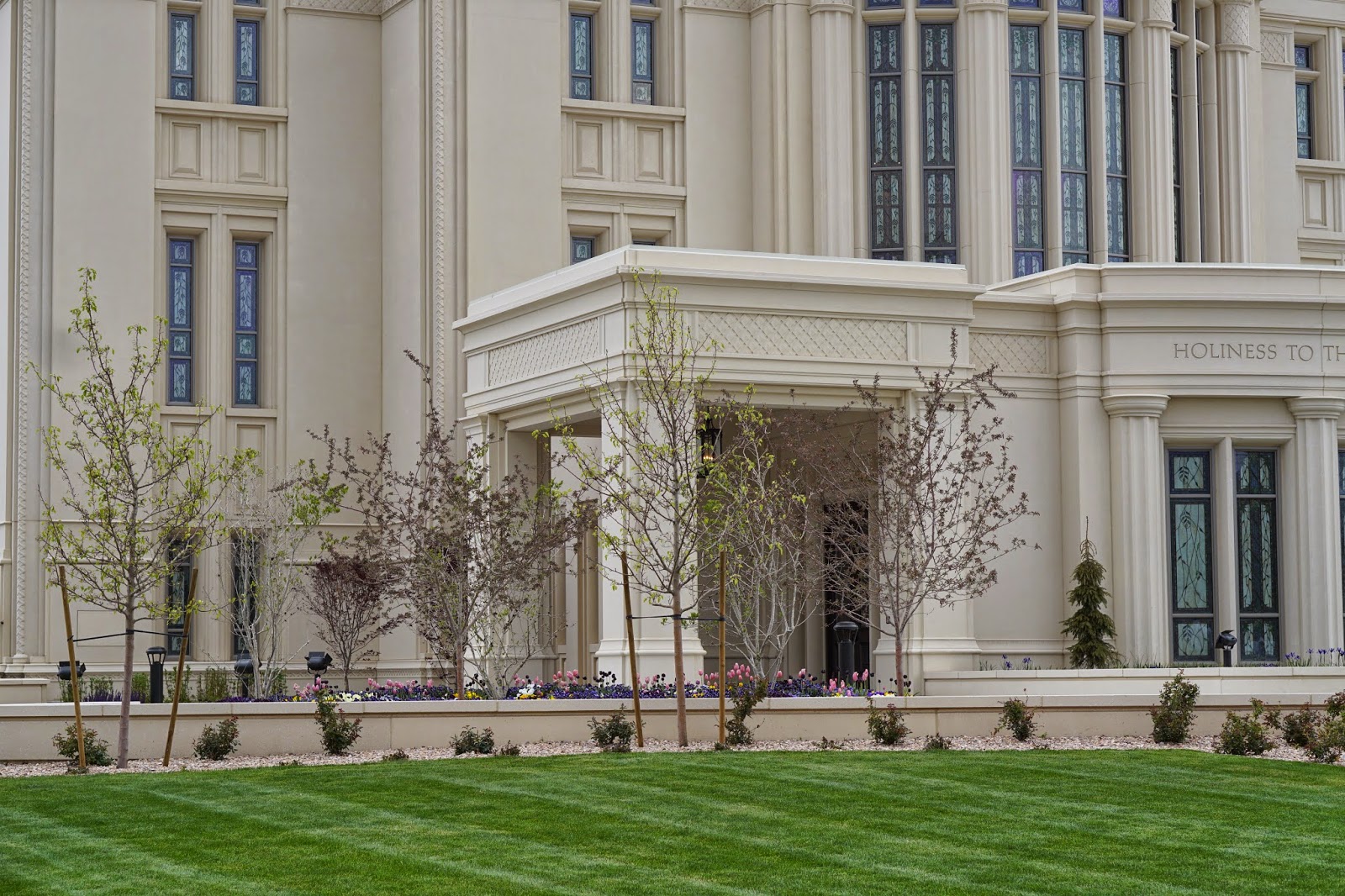
A temple for Saratoga Springs

Eight years ago, I watched from a distance as my secondary hometown, Payson, Utah, got a new temple. I attended the ground-breaking, open house, and dedication, so I suppose I was a more active participant than "watching from a distance" lets on, but I knew this wouldn't be a temple I visited regularly. When you live in Utah, an hour is more than most of us are willing to drive to get to a Latter-day Saint temple.

A few years later, another temple was announced for Utah County: Saratoga Springs. I lived in Midvale at the time and was happy to hear that new temples were getting a little closer to Salt Lake County (my temple, Jordan River, was always insanely busy), but didn't know at the time that this would one day be my hometown temple.

Construction started making real progress in 2020, after I'd lived in Eagle Mountain for two years and had made the field that separated the temple from my neighborhood one of my walking routes. 

I've been dreading the extra traffic on Redwood this temple will bring, but it's easy to see why they picked this spot for the temple. The view of the lake and mountains is spectacular.

While we were stuck in COVID limbo, construction on the Saratoga Springs Temple was one of the only things in my life that was progressing at all. Once those walls started to go up, I took a temple selfie every time I was out in that field to mark its progress. Having grown up in a semi-remote town that required a car to get anywhere, living within walking distance of something so majestic made me feel, well, cool. That's when it really started to feel like my temple. 

October 2020. Yes, I was ridiculously late to the wireless headphones party.

After some supply-chain delays, the open house finally started earlier this year, and lasted for 12 weeks, the longest open house in the history of the church. This gave me plenty of opportunities to volunteer. I provided background music in the chapel next door three or four times and served once as a counting usher. Of course I was happy to help with the music, but I was also excited to put one of my other natural gifts to good use as a counting usher: sitting silently in the corner. 

About halfway through the open house, my giant singles ward was split into three. I ended up in one of the new wards, helmed by none other than the guy who was in charge of the ushering committee at the open house, a role that was basically a full-time job and involved working with thousands of volunteers—not to mention visitors—every day. He and his wife got the call right there in the temple.

My entire bishopric, in fact—and their wives—was heavily involved with the open house ushering committee. Amidst the chaos of building a brand new ward from scratch, the bishopric arranged to give our ward a private tour of the temple, which would include walking through rooms that weren't part of the regular tour.

Despite the early start time—7:30 a.m. on a Saturday, before the regular tours started at 9—many of us jumped at the chance. I was especially looking forward to seeing the bride's room and the children's waiting area. (Mom, you would have LOVED the adorable, exquisite table and chairs in the children's waiting room.)

But I soon realized that the bishopric had more in mind than a special VIP tour. This truly was a once-in-a-lifetime experience. Many wards do ward temple days, but most have never had the opportunity to book the entire temple for just their ward. To not only look around, but to be instructed and inspired by their leaders, like the early saints had done during Joseph Smith's time. 

We did. 

Seeing the stained glass windows and beautiful artwork (so much artwork!) and intricate architectural details is a sacred experience on its own. But it was the times we gathered together in the larger rooms that I'll remember most years from now. As we sat in a couple of the chapels, a sealing room, and an endowment room, each member of the bishopric and their wives took some time to bear their testimonies and share some of the miracles they had witnessed during the open house. Our brand-new Elder's Quorum and Relief Society presidents shared some thoughts as well. And when we were in the Celestial Room, we sat in silence for about 10 minutes, pondering and soaking in the sweet spirit that surrounded all of us.

It was one of the most spiritual experiences of my life. One of those times where you don't just feel the Holy Ghost on the inside—you feel it outside of you too, in the very air around you. It was a feeling so all-encompassing it took days to wear off completely—I had an unusually good week after that, which are hard to come by in the summer.

If you need help finding me, I'm the one who's having the most trouble keeping my eyes open with the sun blasting us in the face. 

Latter-day Saint temples are more than beautiful edifices. They're not meant to be a status symbol, or a reminder of the church's wealth. They are literal houses of God, where we can feel peace and do work that has eternal significance. Even seeing the Saratoga Springs Temple when I'm driving around or out on my walks gives me hope. Temples dotting the earth are a blessing for everyone, and I'm excited to continue to be a part of the newest one in Saratoga Springs.

Temple lights + supermoon = pure awesomeness

Sunday, February 23, 2020

It all started on a farm


There once lived a young boy who lived in a simple log cabin with his family. He worked hard alongside his siblings and parents and was generally considered a good kid.

But like most teenagers, he had questions. One question in particular troubled him, so one day he went into the woods by his house in search of an answer. What he found there would change the world.

If you've ever read a fantasy novel, this story should sound familiar. It's almost always about a youth who lives in a small town who discovers a dragon in the woods and goes on to fulfill a great destiny and save humanity. It's a formula that works—people just want to see the little guy win.

The origin story of The Church of Jesus Christ of Latter-day Saints is similar. Joseph Smith went from a country farm boy to the founder of what would become a worldwide religion. One that has millions of members today and that blesses the world with its message of Jesus Christ and its charity work fueled by tithes and an admonition to serve others.

Whether you believe that prayer is a way to communicate with God or a useless waste of breath, there's no denying that the result of Joseph Smith's prayer regarding which church to join made an immediate and lasting impact on the world.

The Sacred Grove, circa July 2018.

President Russel M. Nelson has urged members to ponder the First Vision story and how it's affected them personally. Trying to figure out where I would be without the founding of the church that is the central focus of my life can be fun to think about; it also makes my brain hurt.

But thinking about who I would be without the gospel isn't as fun of an exercise. It's hard to imagine who you would be without your core foundation. I know many, many wonderful non-members who don't need religion to make them better people and who don't need faith to drive their everyday lives. But as for me, I need these things. And most importantly, I don't know how I would make it through difficult trials without access to all the gifts the Restoration of the gospel provides: prayer, priesthood blessings, knowledge of why we're here and where we're going, even callings. Life is hard enough with the peace and hope the gospel brings. Take that away and life would just be unbearable most of the time.


I visited the Sacred Grove a couple of summers ago with my family. I always find nature peaceful, but this grove of trees took that feeling to a whole new level. Even as I was being eaten alive by mosquitoes, I felt the sacredness of that space. We Latter-day Saints love our historical landmarks, but this one is especially worth visiting because of the question that was asked in these trees that shaped the lives of so many: "Which church should I join?"

Joseph got more than he bargained for when he asked that question. I wonder if he ever had a Frodo Baggins moment, wishing the monumental task of restoring the Church of Jesus Christ upon the earth could have fallen on someone else.

"I wish the Ring had never come to me," Frodo said. "I wish none of this had happened."

Gandalf likely expected Frodo to be discouraged and afraid, so he was prepared with a response Frodo wouldn't forget. "So do all who live to see such times, but that is not for them to decide. All we have to decide is what to do with the time that is given to us. There are other forces at work in this world, Frodo, besides the will of evil" (The Fellowship of the Ring, Book II).

Joseph knew he had seen God the Father and his Son in that grove. He knew it wouldn't make his path any easier, and that many people would remember him for evil instead of good. But he stayed the course, sealed his mission with his blood, and the gospel he restored lives on today.

Even for little old me, a tiny speck in the universe who doesn't have a grand destiny. The church was restored for everyone, but after pondering how it's blessed my life for 32 years, it feels profoundly personal. No gift could be better.

Good news, indeed.

Tuesday, August 28, 2018

A summer of new experiences

August is just about over, and you know what that means: alternating panic and self-flagellation for wasting another summer.

Except, I'm not getting that feeling. Because I did things this summer. I was too busy living new experiences to be bothered too much by the things I love to gripe about during the summer (the heat, the sleep trouble, the having to go to work—you know the list).

Apartment renter to homeowner


This is the big one, guys—the biggest change I've made since I started working after college. And in almost all ways, it's been a positive one.

But moving from a one-bedroom apartment to a four-bedroom house brings some challenges. Like, finding the energy to vacuum all. that. carpet. And having three levels instead of one—I feel like I'm trekking up and down stairs constantly. And now that I have about 47 closets, it takes me much longer to find lost items (weeks longer, in some cases, because I routinely forget about certain closets). And I have three bathrooms to clean now, because one person definitely needs three bathrooms. Seriously, between the miles and miles of carpet and the infinite number of closets and doors, sometimes I miss that grungy little apartment for its sheer simplicity.

(There's also the commute. Before school started it was long but bearable, but now it adds an extra hour of hell to every work day and I can't talk about it without getting ENRAGED so let's move on.)

But everything else? Awesome. I love how soft and fluffy the carpet is, even if I resent its abundance. I LOVE having a kitchen that's big enough to move around in. No more balancing cookie sheets over the sink or having to move eight things every time I need to cut up some vegetables. I love having a few extra rooms so I don't have to keep all my stuff in my bedroom if I don't want to. I LOVE having a garage to park my car in; it's my favorite adulting thing ever. I love that everything is brand new so I don't have to worry about stuff breaking on me just yet. I love putting any investment into this new space of mine, whether it be cleaning/decorating or putting in a water softener. It's mine to do with what I wish, and there's a certain pride and joy that comes with that.


Another thing I love? I have a library. As if I needed another happy place in this house.


Never been outside the U.S. to world traveler

I finally did it—I traveled outside the U.S., to the exotic land of Canada. Still no stamp on my passport because apparently you have to travel in by plane to do that, but we took many pictures to mark the occasion.


I didn't expect Canada to feel any different from the U.S., but right away I noticed some things that made it feel "foreign." Like their use of the metric system—I'm a dumb American, so I couldn't tell you how much gas costs there in Americanese. You see French almost as much as you do English, and Canadians are super nice. And not in that fake way you get here all the time where we just act nice because we're supposed to, or smile sweetly while plotting ways to murder someone. It's a real, genuine, not-at-all annoying niceness, and I think we should all be like Canadians.

Also, Niagara Falls is incredible. The boat tour was my favorite part of the entire trip.


Singles ward to family ward

This was by far the hardest transition I made this summer, but it had to be done. I may still end up back in a singles ward once I officially hit "mid-singles" age, but for now it's been a nice break from the YSA wards I've outgrown, and it's been a great way to help me get to know my neighbors and actually become a part of the community I live in. Plus, I have family in the ward again, and I was given one of the few family ward callings that doesn't terrify me—primary pianist.

Still, my heart goes out to any LDS single (sorry, Latter-day Saint single) making this transition, because it's rough. I hated feeling like I couldn't blend in anymore, and I really missed quiet sacrament meetings. (Still do.) But it got easier, and eventually I started believing what I kept telling myself—that everyone else is too wrapped up in their own lives to notice how different mine is, and that I share more similarities with these strange married people than I realize.

But, there is one thing I'm not sure I'll ever get used to: calling people Brother/Sister So-and-So. One of the many great things about singles wards is that everyone addresses each other my their first name—like you would in literally every other adult situation—so going back to the Brother/Sister thing feels archaic. It's not quite as strange when the primary people call me Sister Carter, but I'm still holding out hope that this weird cultural thing will die out.

4-time Convention survivor to 5-time Convention survivor

Nothing new about this year's USANA Convention experience, other than it was an easy one for me. ("Easy" being an extremely relative term here.) And that I broke my single-day steps record (22,000). And that I somehow still had the energy to smile on Saturday morning.

Pardon the bags under the eyes. They're part of the Convention uniform.

Cheers to an abundant summer. Even if your summer wasn't abundant, take heart in knowing that the best season has only just begun.

Thursday, January 11, 2018

How Thomas S. Monson shaped my YSA years

There are a lot of ways to chronicle your life, from simply keeping track of ages and dates to lumping experiences into categories like "the middle school/junior high experiment" and "the years I lived in a cheap college apartment."

Leaders have a way of characterizing the time period they lead during as well, as we've seen in the many tributes to President Thomas S. Monson over the past week. I remember a little bit of the Benson and Hunter presidencies, but most of my life can be sorted into either the Hinckley years or the Monson years.

Gordon B. Hinckley was the prophet of my childhood, and is still my favorite general authority of my lifetime. His wit, wisdom, optimism, and down-to-earth work ethic was a backdrop to my life as I rode the crazy roller coaster of teenagehood and early college. "Forget yourself and go to work" repeated itself in my mind often, and the explosion of temples throughout the world was more of a guessing game of "where will we go next?" rather than the unprecedented miracle the generations above me saw it as. 

It was an exciting time to grow up as a member of the Church of Jesus Christ of Latter-day Saints. And every time I hear Pres. Hinckley's voice I feel safe in the way that being back in my childhood home makes me feel safe. 

But if anyone could replace this man as a leader, it would be Thomas S. Monson, the prophet of my YSA years. His influence on my life is right up there with Pres. Hinckley's, mainly because of his stories and charisma. I loved hearing him speak even when I was a kid who thought General Conference was something to be suffered through so I wouldn't have to put a dress on and go to church (a price I was more than willing to pay, might I add).

But the biggest impact he had on me personally can be summed up in one phrase: "find joy in the journey." 

Pres. Monson gave his "Finding Joy in the Journey" talk in October 2008, after being president of the church for less than a year. I remember appreciating it, but, like with most conference talks, I had mostly forgotten about it after a few weeks.

Months later, I was in the middle of a rough patch in college when I asked my dad for a blessing. I was tired of school, tired of college life, tired of singles wards. I longed for the day when marriage and/or graduation would put an end to it all.

But Dad's message to me wasn't how to get to the destination I sought; he merely reiterated Pres. Monson's admonition to find joy in the journey. That time, the message stuck. It's something that's been on my mind a lot as I've jumped onto the completely different roller coaster of young adulthood.

I wasn't always happy to obey, but looking back, it just might be the single most important ideal I strived to live by during the past decade. Everyone talks about Pres. Monson's ability to reach "the one," which could mean anything from dashing to a hospital to visit someone about to pass through this life to hopping on a plane to Germany to visit someone who needed attention. But even for those of us who didn't interact with him personally, he knew how to reach us.

For me, it was one conference talk. Well-spoken words can have just as much of an impact as an act of service. I had no idea at the time how much I would need that counsel, but it's subtly shaped the way I live my life during my young adult years.

Thanks for sharing everything you had with us, Pres. Monson. And for wiggling your ears.

Monday, March 28, 2016

The blessings of discipleship

I've been to a lot of YSA events—both spiritual and not, but I'm talking about the spiritual ones at the moment—and you can almost always count on the M word coming up at some point. For a church that focuses so much on marriage and family, there sure are a lot of us who can't figure out how to get one of our own.

The advice from bishops, stake presidents, and other church leaders is always the same: live a righteous life, and the blessings will come. Be the kind of person you want to marry.

For most of my single years, I've used that promise as motivation to incorporate the Sunday school answers into my life (you know what they are—scripture study, church/temple attendance, etc.). Aside from being social, being a "good Mormon" was the only way I knew of to boost my chances of getting married.

At the face-to-face event for Young Single Adults Jeffrey R. Holland spoke at a few weeks ago, we all waited with bated breath to hear his answer to the question all YSAs struggle with at some point: Why am I not married yet? What am I doing wrong? I'm doing all the things I've been taught to do—why haven't you fulfilled your end of the bargain, God?

I know I wasn't the only one who half expected Elder Holland to give new revelation on the subject. Surely he knows some trick the rest of us haven't figured out yet. But his answer, along with that of Elder Hallstrom's and Sister Stephens', was the same one we've always gotten, one that seems too simple to be of use all the time.

Just be a disciple of Christ, and stop worrying.

Maybe it's because of Elder Holland's eloquence as a speaker and powerful testimony of the gospel, but I started to think about that counsel a little differently. Being a disciple of Christ isn't like buying groceries. You can't just pick the blessings you want and ring them up at the cash register. You can't hand over your credit card, knowing exactly what you'll get out of the transaction. Discipleship requires a lot of faith, and the "exchange" doesn't always feel like it goes in your favor.

Which can really be a bummer, to put it lightly.

Until you remember one thing: being a disciple of Christ is in and of itself a blessing, one that is almost always immediate. If I didn't put forth the effort to study the scriptures, I wouldn't get my daily dose of peace. If I hadn't made an effort to be a regular temple goer, I never would have come to understand the atonement the way I do now. If I didn't pray, I wouldn't be able to feel God's love and assurance. If I didn't walk this path of discipleship, I don't think I would have progressed in any way that's meaningful.

Growth, peace, and happiness—that's all any of us wants, right? Maybe they're not the specific things we asked for, but God finds a way to sneak in extra blessings, even when we're focused on something else.

Tuesday, June 9, 2015

Coming full circle

The Payson Utah Temple dedication was on Sunday. I've debated whether I should blog about the experience, and almost didn't because social media has been exploding with posts about the Payson Temple for weeks now—I'm kind of ready to stop talking about it.

But I blogged about the groundbreaking ceremony and the open house—I can't just leave out the most important milestone.

So even though a lot of you have already heard hundreds of special Payson Temple stories, here is the next segment of mine.

It started with the Cultural Celebration. I feel bad saying this, but the boys in our stake (aka, the stripling warriors) looked like sleep-deprived zombies who had stayed up too late playing video games. But the rest was pretty exciting. It set the mood for the next day perfectly.

*Pictures pulled from KSL.com.


For the temple dedication, I was once again the lucky recipient of having a former bishop as my dad. We got to sit in one of the huge endowment rooms in the temple during the first dedicatory session. Right before the meeting started, we got a little surprise. We were sitting there quietly when a tall man in white walked by, who looked remarkably like Henry B. Eyring. And the guy behind him looked a lot like Quentin L. Cook . . .

We all sat there a little stunned as these two men we've seen countless times on TV walked to the front of the room and showered us with smiles, waved, and then moved on to the Celestial Room where the meeting would take place. Kind of a heart-stopping experience, but not one I'll soon forget.

The cornerstone ceremony was one I hadn't seen before, probably because I usually elect to go to one of the afternoon sessions so I can sleep in a bit longer. I was a little worried about all those people sealing the cornerstone with that "really nice mud" in their white clothes, but fortunately, none of them had the Carter tendency to spill things on themselves.

Can I just say that Pres. Eyring is adorable? He always seems to have a laughing smile on his face, as if he's so full of joy he can barely contain it.
But the best part was the prayer. Yes, it was long, and not as interesting as the talks. But that's not what I was tuning in for. I was waiting for that moment when the temple went from being a magnificent edifice to being a house of God. When Pres. Eyring started dedicating each part of the temple, there was a palpable change to the feeling in the room. The temple has always had that spirit about it that makes it "our" temple, but in that moment it became so much more. It became our Heavenly Father's temple, too.

Singing "The Spirit of God" was a neat experience, as well. I felt that tie to the early Saints more strongly because the temple was filled with thousands of voices singing praises, just like at the Kirtland Temple (only on a much larger scale).

And now, the Payson Utah Temple is the 146th operating temple. The special experiences have only just begun.


Tuesday, May 5, 2015

A temple for Payson

It was during a five-minute break from my evening ASL class that I got the news. Payson was getting a temple.

And it wasn't folklore this time; we had an official Church press release affirming that fact.

It's difficult to describe the emotions that course through your body when you get this kind of announcement. Over the next few days I went through stages of shock, excitement, incredulity, gratitude, and joy. Utah (at the time) was home to 13 temples, but this temple would be for little ol' Payson. My people.


Some of those feelings came back when I went to the open house yesterday. Strangeness at seeing such a magnificent structure where there used to be a simple field (and during some of my pizza delivering days, the road didn't even stretch out that far). Surprise when I recognized some of the ushers. The complete incredulity of feeling like a tourist in my own town, a town that doesn't have any tourist-y attractions (except for, perhaps, Peteetneet Academy, but the only people who would drop by to see that building are Payson natives).


And once we made it inside, it wasn't just the beauty of the apple blossom motifs, the hand-painted gold trim, and the abundance of stained-glass windows that pleased the eye and spirit. It was the extra Payson-ness—the paintings of familiar mountains and scenery, the work done by local artists. All the little reminders that this temple was built with the people of Payson in mind. The building captured the feeling of home in a way no other temple can.


I'm probably biased, but it's one of the most beautiful temples I've ever seen. I may not live in the temple district anymore, but I'll still be proudly claiming the Payson temple as my temple.


Friday, May 1, 2015

Why YSA wards are proof of God's love

It's a truth universally acknowledged that single twenty-somethings are the red-headed stepchildren of Mormon culture. Each family ward has a place for children, youth, and adults, but those of marriageable age with no children suddenly find themselves without a niche.

The solution? Throw them into a singles ward! Marry them off as quickly as you can so they can move back into a real ward and finally feel comfortable with real adults!

Okay, so it's not that bad. Except, sometimes it feels that way. Sometimes I worry that the comical, negative stereotype super-glued to YSA wards is the only perception people have of YSA wards. That they view those who didn't seize the low-hanging fruit in their early twenties as too weird/selfish/lazy/immature to get married.

And I'm not just talking about others here—I thought the same thing until I became one of those single twenty-somethings.

When in fact marriage really has little to do with singles wards in the first place. It's often a side effect, yes. But after 7 1/2 years in a YSA ward, I've felt more and more strongly that these wards were created because God loves his YSAs, not because he wants to "fix" them.

My first YSA ward was a BYU ward. To my 20-year-old self, it was like an unsupervised playground that spontaneously shot couples with Cupid's arrows. Even beyond that, it was a haven, a place of belonging. This was a ward specifically for me and all the other transitioning adults in my small corner of Provo.

I never thought I could learn so much from people my own age, or that church would still feel so right in a setting without families.

Being surrounded by budding romances did wear me down toward the end of my BYU experience, though, and I lost sight of all that is good about singles wards for a while. I felt like that guy from that Singles Ward movie, who, after his divorce, was more upset that he would have to go back to a singles ward than that his marriage had ended.

My perspective shifted when I moved to Midvale and started going to a newly formed singles ward, where beards were rampant and college graduates were the norm. Refreshingly one of the young ones of the ward again, I felt more at home at church than I had in a while. The pressure to get married was still faint, but I was surrounded by people in the same boat I was—trying to make the most of a life experience most of us didn't expect to have.

And being part of a singles ward is an integral part of that experience. It provides you with people who roll their eyes with you when someone admonishes you to "try a little harder" at dating, like it's that simple. (And they're also the ones you listen to when you really do need to try a little harder.) You have a support group to lean on when all of your friendships change because your friends are married and you are not. Sunday School, Relief Society, and Priesthood lessons are relevant to your life today, not the one you hope to have in the future.

But it's more than just the sense of community and commonality. It's the way your relationship with God strengthens as the regulars in your life diminish. It's the trust your bishopric has for young adults to fulfill the "important" leadership callings in the ward. It's the way the ward focuses on you and helping you reach your potential.

I haven't missed going to a family ward for a long time, and I know I'll be really sad when I have to leave. Because YSA wards aren't just a solution to the twenty-somethings problem—they exist because God watches out for all of his children, even the misfits.

Monday, April 20, 2015

Read the Old Testament: Check

It took about five years, but I can finally check off "read the entire Old Testament" off my bucket list.

Given the length of time it took to complete it, this goal clearly wasn't a top priority. (I can only think of one other book that took me longer to read—Little Women. I started it in junior high, picked it up sporadically throughout high school, and then finally started over and gave the book one last try after graduating from college. Incidentally, it is now one of my favorite books. Timing is everything, my friends.)

One of my favorite classes at BYU—possibly the favorite—was the Bible as Literature. We studied the bible from historical and literary perspectives, something you don't get to do much in your typical LDS Sunday School class. To make things even more interesting, Dr. Eliason didn't assign a specific edition for the entire class; instead, he asked us to pick out a couple different versions and base our study on those. (This made read-aloud sessions more fun—it's fascinating how much the translations differ from each other.)

I went a little beyond the minimum book requirement (my checking account wasn't happy about it). But this English major couldn't resist the "prompting" to just buy one more . . .
And just like that, instead of the dry, hard-to-understand text I had previously associated with the bible, I had a book of stories akin to Aesop's Fables or Hans Christian Anderson's fairy tales (although some of the stories are definitely more Grimm.) During that semester, I discovered so many new stories and understood some of my old favorites in deeper, more satisfying ways. Who knew you could learn so much from the line "and Eglon was a very fat man"? Who in this modern era wouldn't enjoy a story about a young woman who pounded a tent peg through her captor's head rather than wait for rescue?

The bible is full of stories like that, and unfortunately we couldn't cover all of them in four short months. Never fear, I told myself, you can read the entire thing on your own time.

Which is what I did, although it wasn't quite the experience I was expecting. Turns out it helps to have a bible expert at your side to provide context. And some of it is about as interesting as an inventory list. Not to mention the stuff that is just plain incomprehensible. (Think Isaiah is hard? Then you haven't tried Ezekiel.)

But you know the phrase "You only get out what you put in"? That is essential to Old Testament scripture study. You can't peruse through it like you would a picture book and wait for knowledge to pop out at you with lots of pretty colors. Those inventory lists, family trees, and detailed laws may not be fun reading, but if you start to think about why they're there, you might learn something anyway. If you're paying attention, you'll find that many of the men and women have personalities—they're real people, not one-dimensional stick figures who exist solely to teach lessons. And most importantly, stories about talking donkeys and whales that swallow humans and large bodies of water that are split in half still have so much relevance to the boring, troubling, and confusing things we deal with every day.

I am by no means an Old Testament expert yet, and I plan to dive back into the book many more times to dig out more treasures.

But for now, on to the New Testament!


Saturday, October 11, 2014

Missionary friends

When I go on my walks, I'm rarely in people mode. I pay attention to the audio coming from my iPod and whatever season we're being blessed with at the time, but I ignore people as much as possible. Occasionally an outgoing child will tag along and strike up a conversation until I walk out of their radius, and ward members will stop and wave from time to time, but usually I get what I set out to get: an hour of me time.

However, there is one group of people who don't let my headphones and averted eyes stop them from approaching me: missionaries. I've met many missionaries on my walks. Elders who look younger every time I see them. Smiling sisters. Senior couples who seem to be at complete peace with the world.

I'm not always eager to stop and make chit-chat, but I'm always glad they made me stop anyway. Even though they find out right away I'm LDS, they don't cut our conversation short to go talk to someone who might boost their numbers. They don't even ask me for names of people I know who need to hear the gospel. Their focus is always on me. They find out everything about me they can during those 15-minute conversations, and rather than feel annoyed at their prying like I usually would, I am deeply appreciative that they were bold enough to reach out and remind me that God will pour out his love for me in any way he can.

It's missionaries who truly capitalize on bold living.

Wednesday, October 8, 2014

When boldness isn't the answer

I've talked a lot about the virtues of boldness, but it also has a dark side. Too much boldness can lead to recklessness and burnout at the very least.

In Alma 38:12, Alma the Younger counsels his son Shiblon to "use boldness, but not overbearance." By way of background, Shiblon was the the quintessential middle child: not as popular as Helaman, not as rebellious as Corianton. His dominant trait was his steadiness in his beliefs and faith in God.

One of the overarching themes in The Book of Mormon is "moderation in all things," which is exactly what Alma is teaching Shiblon here. Boldness is good, but it shouldn't dictate how you do everything. A daily dose of boldness won't do any harm, as long as you remember that some things need to be done gently.

Here's an index outlining situations in which boldness is the answer.

Sunday, October 5, 2014

Boldly defend temple standards

Religion is a major piece of our world's history. During most of the time humans have inhabited the earth, they were believers. Beliefs changed and evolved, but people for the most part shared the same moral code.

That's not the world we live in today. In a very short amount of time, we went from being people who believed first to those who doubted first. The moral code that worked for centuries is now considered archaic and restraining.

This is a topic general authorities have addressed for years, especially lately with the Ordain Women movement and the ongoing fight for the legalization of gay marriage. As other organizations and religious groups have one by one lowered their standards to give the world what it demanded, The Church of Jesus Christ of Latter-day Saints has boldly stuck to the standards the Lord has set.

Because that's the way we have to live our religion now: boldly. There are a legion of factors waiting to turn our beliefs into an unrecognizable mess—we can't afford to live our religion timidly or casually. To stand firm in a world that cares more about political correctness than the God who is in charge of it requires courage. In a world that elevates relativity in the place of absolute truths, we must be willing to go against the grain.

As Lynn C. Robbins said this morning, we must "boldly defend temple standards." The Church doesn't need to be defended—it will prosper without us—but we need to defend the Church. Everything that's worth having must be protected, even our testimonies.

Click here for more on bold living.

Saturday, October 4, 2014

The bold apostle: Elder Holland

Elder Holland's talks are consistently among my favorites. I always feel a little cheated when he speaks in the priesthood session instead of one of the general sessions. Good thing that didn't happen this year.

It wasn't a hard decision to feature Elder Holland in this series on boldness. (The only other apostle I considered was Elder Oaks, whose "Thou shalt not hang out" talk of 2006 still rings in young single adult's ears.) He's not afraid to call us to repentance, to broach uncomfortable subjects, or to bear his testimony to a sea of doubters. He continuously makes me want to cheer, while forcing me to confront my weaknesses at the same time.

It's hard not to imagine such a powerful speaker as being powerful in stature, as well. 

About 10 years ago, Elder Holland presided at our stake conference. Between the only stake president I could remember being replaced by our old bishop and Elder Holland's appearance in little ol' Payson, that meeting was the most memorable stake conference I ever attended.

In typical Elder Holland fashion, he bluntly told the youth of the congregation that we weren't smart enough to make all of our own decisions. I wasn't the only teenager who looked around uncomfortably when he commanded us to trust our parents and leaders because they knew what's best for us.

But he didn't spend his whole time yelling at us, as one of my seminary classmates complained about the next day. He also introduced us to a novel concept (novel to me, anyway): love is multiplied, not divided. I'd like to blame my teenage-girl mindset for my surprise and awe at this statement; I had a hard time picturing someone acquiring a new best friend without shafting the former best friend. I loved my favorite people fiercely, but there was a part of me that thought I had a finite capacity for love. I didn't want to spread myself too thin. 

Even now, I have to remind myself that love isn't like a cube of butter, capable of enriching the taste of only 12 pieces of toast before running out. Love is its own miracle; it increases the more you use it.

After the meeting, Dad escorted his wife and five shy children to meet Elder Holland. I was torn between wanting to slink out unnoticed and wanting to meet my favorite general authority. 

When we finally made it to the front of the room, I was a little disappointed by how old and frail he looked. Here was a guy who could make people cower with his words, and he was shorter than me. He didn't even have a firm handshake (I suspect he was trying to preserve his energy). But when he looked me in the eye and thanked me for coming, I saw the boldness he lacked in his handshake burning in his pale blue eyes.

So when Elder Holland speaks, I shut up and listen.

The index is still here.

Sunday, April 21, 2013

A special kind of shepherd

Today my ward was combined with another ward and my bishopric was released. It's the fifth time in two years my ward has been shuffled to another building. Salt Lake singles wards tend to be quite a bit larger than BYU wards—alas, the ward boundaries actually cover more than half a block—but the Union YSA ward is one of the runts of the singles wards in the Salt Lake Valley, though its fierce "unicorn" pride makes it one of the more well-known wards of our stake. It's hard to forget the Union Unicorns when they show up to every basketball, football, kickball, and softball game wearing homemade unicorn headbands.

So today was a new beginning of sorts, and was filled with the nervous excitement that accompanies the beginning of every new singles ward. It's impossible not to be excited at the prospect of all that fresh new meat.

As each bishopric member being released, along with their wives, spoke to a congregation of snifflers, I thought about each of my singles wards bishops and how they helped shape me into the person I think God wants me to become.

Bishop Long, my first singles ward bishop, recognized that I was a brand new fish in an unusual and friendly pond and introduced himself to me on my very first Sunday. It took him a while to remember my name, but he always knew who I was. He entrusted me with a variety of callings and helped me grow from scared teenager to a competent adult.

Bishop Dort was the kind of person who could look straight into your soul and make you want to be a better person, without even saying anything to you.

Bishop Davis was integral in my preparing for the temple when I did. He knew before I did that it was time for me to get my endowments, that I would need those blessings well before I needed marriage.

Bishop Ayre, my bishop who was released today, was my bishop during some of the most tumultuous periods of my life. I wasn't well known throughout the ward and never had an "important" calling, but every week, without fail, Bishop Ayre was there to greet me with a smile and a "How are you?" During this time most of my spiritual growth happened independent of my role in the ward, but I never felt like a lost sheep and I know without a doubt that he prayed for me regularly.

Singles ward bishops are a special kind of shepherd. They are given the daunting task to act as counselor, father, teacher, disciplinarian, and servant in a way that is quite different from bishops of "normal" wards. They are in charge of an entire flock of young people who are trying to figure out who they are and what their place is in the world, who are making important decisions all the time that will affect the course of their lives. Without their parents' constant supervision, it is so easy for these young people to fall off the face of the earth. A singles ward bishop's job is to make sure that doesn't happen, and, in my experience, they do a spectacular job of it. Singles wards are a powerful testament to me that God loves each of his children, and is mindful of the unique challenges young single adults face in today's world.

Today I moved on to singles ward bishop number five. It's always hard to say good-bye to a beloved leader and accept someone else, but already it's apparent that the mantle has shifted. I'm looking forward to seeing what influence Bishop Beveridge will have on my life journey.

Thursday, July 26, 2012

An unconventional 8-5 week

I like having an 8-5 job. I like the stability and predictability (try saying that five times fast) that comes with it. I like waking up at the same time every day, having a pretty good idea of what to expect for the day ahead.

But even for those who don't mind sitting at a desk all day, doing the same thing day in and day out can get kind of boring, even if tasks and meetings keep you busy. A field trip to Office Max or an hour-and-a-half lunch break can go a long way in breaking up the tedium just enough to keep you content with the tedium.

My week so far has deviated from the norm quite a bit, adding a few more firsts to the story of my life.

Sunday
  • While Sunday is not part of the typical work week, this Sunday's normal flow was disrupted slightly due to the fact that the entire bishopric was out of town. Our elder's quorum president conducted sacrament meeting, and he looked like a freshly ordained elder who is still getting used to wearing a suit, which he hasn't quite grown into yet.
Monday
  • I've written a lot of video scripts for marketing videos, and I've seen the finished products that were created from the scripts, but I've never witnessed the important middle part: shooting the video. I got to watch a real director and real actors try to impromptu their way through awkward segments. I was one of many who stood in the background, away from the lights and camera, watching the actors as they struggled to remember lines they looked at for the first time that morning. I was a bit mystified by the number of times the crew adjusted an actor's tie or told them to wipe the invisible sweat from their forehead. I am still amazed at the amount of skills and people required to create a 30-second video.
  • I also had my first (and hopefully last) cameo appearance, which featured Shari and me sitting awkwardly in the background.
  • I ate in a coffee shop for the first time. My curried-chicken sandwich weirded me out. People watching was fun though.
Tuesday
  • July 24th--the holiday that isn't a holiday. It was a normal day for me, but not normal enough to stop the booms and pops that echoed through the darkness that night (thankfully people were done making noise by about 11:30).
Wednesday
  • In honor of a departing co-worker and to welcome a new one to the crew, we went to Cafe Rio for lunch. Seriously, I don't know why I don't take real lunch breaks more often.
As for today, well, I can't believe it's Thursday already.

Monday, October 24, 2011

The difference between Provo and Salt Lake YSA wards

I'll admit, I was relieved to find that the church is just as true in Salt Lake as it is in Provo, even though the 50-mile dividing line between the two cultures is pretty strong.

However, my first time in a non-Happy Valley YSA ward has portrayed some notable differences from a typical Utah County YSA ward. For example:
  • Obviously, there's this school in Salt Lake that a lot of people are loyal to. . . . However, my entire bishopric graduated from BYU, so when BYU lost to Utah, there was pain at the pulpit that day rather than gloating. As it should be.
  • Those of us up north actually get to meet in a real church, rather than a classroom on campus. No sacrament meeting in the testing center for us.
  • The very first speaker at our adult session of stake conference last week had a full-blown Mohawk. There is no way a BYU bishop/stake president would have allowed that to happen, but in Salt Lake it isn't really cause for concern. (He gave a very good talk, by the way. And his closing line was classic: "I'm trying to get into law school, I play guitar in a band, and I love to ski; I'm a Mormon.")
  • Stake/regional conferences often take place in the Conference Center downtown. As much as I like the Marriott Center, the Conference Center is way cooler. Yesterday I sat in like the 8th row of the bottom section and could actually see the speakers, the chairs are way more comfortable, and I'm pretty sure Elder Bednar looked at me directly when he was waving good-bye to the congregation at large.
  • At BYU, all we ever talked about was dating, marriage, and marriage. My SLC ward still has its obligatory relationships class, but our theme from the start has centered on missionary work. It is refreshing to be relieved of the marriage pressure thing, but I'm no better at the missionary work thing, so, frankly, I can't decide which one is more annoying.
  • This may be because I always lived south of campus, but the average age was much younger in Provo than it is in SLC. At 24, I would have been considered ancient and way past marriageable age in Provo, but in Salt Lake I am one of many in the mid-to-late twenties. I can't express enough how nice that is.
  • A lot of famous (Mormon) people live in the Salt Lake area. Utah County gets its fair share of Mormon celebrities, but most of them call the Salt Lake area home. My ward specifically has already hosted firesides for Thurl Bailey, Elizabeth Smart, an ex-Oakland Raiders football player that I can't remember the name of, and many other big names.
  • Utah County still only has one operating temple; Salt Lake County has got at least five.
  • Facial hair and "extravagant" fashion styles aren't frowned upon in Salt Lake.
Despite the subtle differences though, all the important things are still the same, including the nuances that make singles wards different from any other congregation in the world.